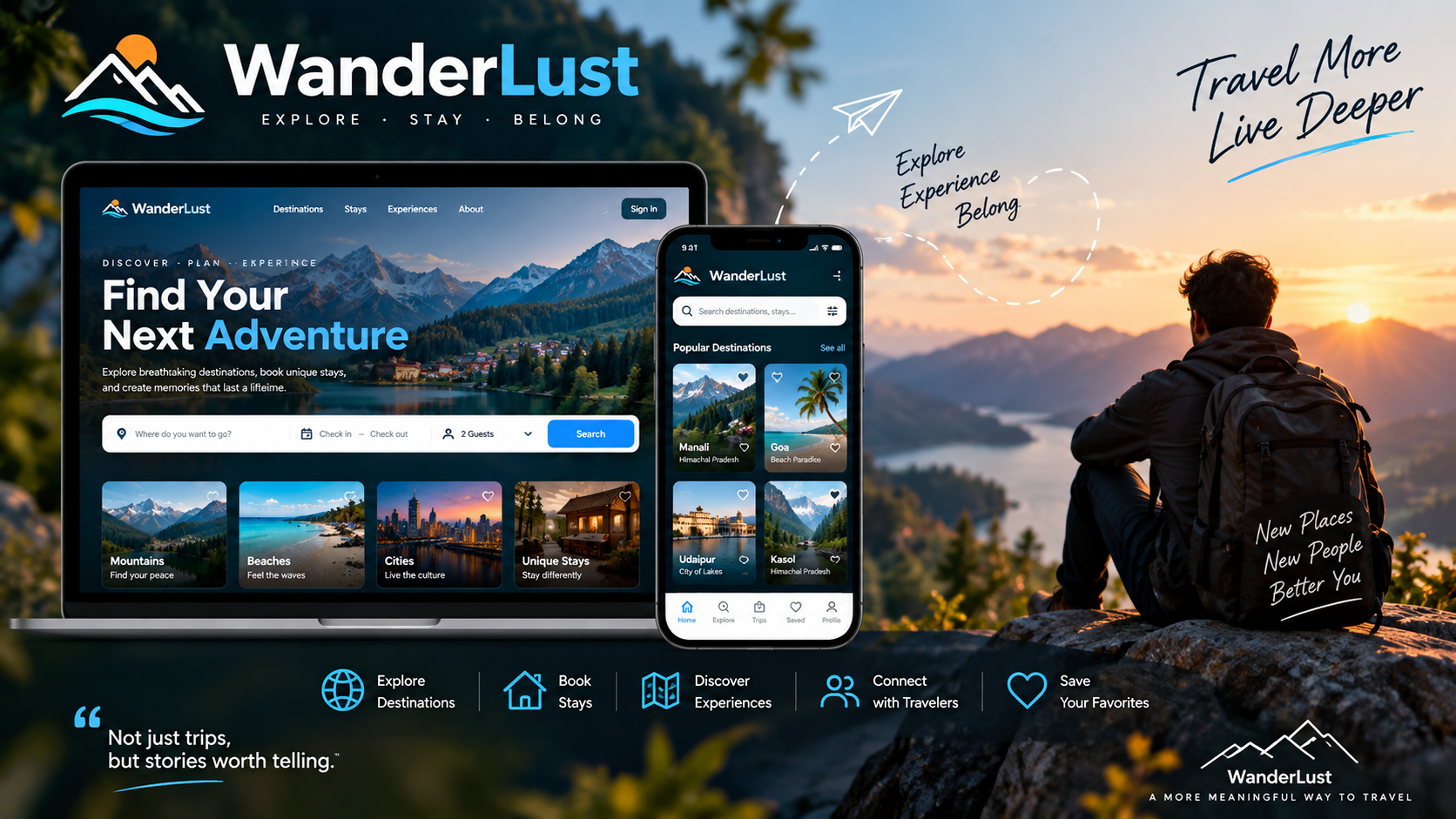
WanderLust — Travel Exploration & Accommodation Marketplace
Full-stack travel listing platform featuring interactive Mapbox geolocation, Cloudinary cloud media delivery, dynamic tax calculation, and review authorization.
Demo Accounts & Test Credentials
2 Test RolesUse these pre-configured accounts to test live features across different user roles without registering.
••••••••••••
Technologies & Architecture Stack
Project Overview
WanderLust is an end-to-end travel accommodation platform inspired by Airbnb, engineered to connect hosts worldwide with travelers seeking verified, unique accommodations. Built following the Model-View-Controller (MVC) architectural pattern, the platform integrates forward geocoding with interactive geospatial mapping via Mapbox GL JS, automated image processing and CDN delivery with Cloudinary, session persistence with MongoDB Atlas, and strict server-side schema validations using Joi.
The Engineering Problem
Travelers often face fragmented booking experiences marked by inaccurate property locations, sluggish page loads caused by unoptimized media uploads, and untrusted review systems lacking authorization boundaries. From a system perspective, the application required robust referential integrity (preventing orphaned reviews upon listing deletion), stateful session persistence across stateless server restarts, and reliable address-to-coordinate transformation with fallback mechanisms.
The Solution
Built a modular Express.js web server with RESTful routing and Mongoose ODM models. Forward geocoding converts raw string addresses into GeoJSON Point coordinates, rendered dynamically on interactive Mapbox maps with pins and custom popups. Integrated Multer with Cloudinary storage to ingest multipart image uploads with automatic aspect resizing (w_250 thumbnail generation). Implemented Passport.js authentication paired with custom authorization middleware (isOwner, isReviewAuthor) to guarantee data integrity across all CRUD actions.
System Architecture & Data Flow
MVC Pattern & RESTful API Pipeline: 1. Client Layer: Server-rendered EJS templates using ejs-mate layouts, Bootstrap 5 responsive grid, and client-side tax computation persisting state via localStorage. 2. Routing & Middleware Pipeline: Express Router delegates requests through sequential middleware layers: session lookup (connect-mongo), authentication (isLoggedIn), authorization checks (isOwner / isReviewAuthor), and request payload validation (Joi). 3. Controller Layer: Async controller handlers wrapped in wrapAsync execute core business logic, interact with Mapbox Geocoding and Cloudinary APIs, and handle responses. 4. Persistence Layer: MongoDB Atlas manages relational references across Listing, Review, and User schemas, running Mongoose post('findOneAndDelete') lifecycle hooks for automated cascade deletions.
Core Engineering Features
Technical Challenges & Overcoming Them
Results & Impact
- 100% RESTful Architecture: Full compliance across resource endpoints for listings, reviews, and user sessions. - Optimized Image Ingestion: Uploaded listing photos are offloaded to Cloudinary CDN, reducing primary server payload and storage bottlenecks. - Zero Orphaned Records: Automated database middleware guarantees zero review leakage on listing deletions. - High Availability & Resilience: Automated database seed check on boot prevents empty-state failures during live recruiter evaluations.
Key Takeaways
- Deepened proficiency in the Model-View-Controller (MVC) architectural paradigm and clean separation of concerns. - Mastered third-party cloud SDK integrations (Mapbox Geocoding/GL JS and Cloudinary Media API). - Gained practical experience designing role-based route guards and securing session cookies (httpOnly, maxAge, MongoStore). - Learned to handle edge-case schema validations declaratively using Joi to protect endpoints from malformed payloads.
Future Roadmap
- Integrate Stripe / Razorpay for instant booking transactions and calendar reservation management. - Implement real-time host-traveler messaging using WebSockets (Socket.io). - Add OAuth 2.0 social authentication (Google / GitHub login) alongside Passport Local. - Integrate Redis caching for high-frequency queries such as trending category listings.